Why is this subject in the Neighborhood Forum Section of the eNews?
 BNC publishes articles in this Section that are written either by a neighborhood representative without editing or is summarized from material which has been submitted to us. In this instance, BNC received an inquiry about yet another piece of State Legislation authored by our State Senator Nancy Skinner that raised concerns over and above the bill itself that we put it here with the intent of encouraging all of you to tell us what you think.
When did BNC first hear heard about SB 1227?
April 30, 2018 in an e-mail from Charlene Woodcock as follows:
I don’t much like Berkeley Considers, since it doesn’t reach most Berkeley voters and thus you get disproportionate responses from those who sit in front of a computer too much.
My quick reading of the recent Berkeley Considers email raised serious questions in my mind, although I support the University providing more student housing and certainly support efforts to terminate facilitation of internal combustion engine vehicle use (replace them with electric vehicles fueled by solar carports and roofs!).
But the Skinner bill seems to be based on the assumption that these buildings for students would be privately owned rather than publicly-owned dormitories. If the university builds a dormitory, they don’t have to abide by city building and zoning codes, do they? If so, then this is really another bill for developers, like Skinner & Wiener’s SB 827 was.
I would certainly hope the Berkeley City Council would not support any effort to further privatize our university. The Administration should be lobbying the state legislature for money to build dormitories, not engaging in more public-private developments that are for-profit and will not provide enough affordable housing most students need. This is a road to privatization and corrupt practices—not what we want from our great public university system.
And before making car ownership more costly and difficult, there should be a survey and assessment of car-owning students. It could be that some of the poorest students rely on a car for family visits, e.g., to the Central Valley, where some might have family obligations and which isn’t served adequately by public transportation.
Ms. Woodcock also included in her e-mail comments posted by a resident who objected to the bill for the following reasons:
- The Berkeley Considers item is misleading. The bill does must more than increase student housing and restrict parking.
- It prevents the City from legislating against overcrowding, by requiring no limits on occupational density.
- By making full time enrollment a housing requirement, the bill allows evicting students who must enroll less than full time in the middle of their academic program.
- It rewards private landlords for creating housing that discriminates on the basis of age and family structure and pits student needs against the needs of other vulnerable communities in competition for potential development sites and resources.
Do YOU and Your Neighbors Know About “Berkeley Considers”?
It’s a city of Berkeley (COB) “online forum intended to broaden civic discourse in a constructive and civil manner.” Go to the COB website, enter in the search box, “Berkeley Considers”, click on that and enter your e-mail address and you will be sent notices about the topics that are or will be included. If you wish to comment on a topic, you will need to further register your name and address and set up a password. However, when you make a comment your name is not disclosed unless you want it to be.
How was the Question Posted on Berkeley Considers?
“Should the City Council support SB 1227, introduced by Senator Nancy Skinner, which seeks to increase student housing and remove vehicular parking ratio requirements in developments consisting of full-time university/college students?”
No details about the bill were stated, nor how one might find those details. The question is now closed, but states that on this question, it had “138 visitors, with 56 responses @3 minutes per response, that’s 2.8 hours of public comment.” And 32 of the responders said yes (57.1%), 22 said no (29.3%), 2 had other comments.
What is SB 1227 All About?
It’s an amendment to current State Density Bonus law. It provides that a developer who agrees: 1) to build 5 or more units of housing; 2) where all units are required to be rented to students who are enrolled full-time in an accredited institution of higher-learning; and 3) will set aside 20% of all of the units for lower-income students will be entitled to a Density Bonus.
A “unit” is defined as one “rental bed” that must remain affordable for 55 years. This Density Bonus would allow the developer to increase the total number of units in the development by 35%. This means such a development could be of a greater height or lot coverage than allowed, or a similar type of action that would allow a greater number of units than would be allowed under the zoning allowance for that parcel.
Lower-income is defined as a student whose income and asset level does not exceed Cal Grant A or B, as proven by an affidavit from the institution he/she is enrolled in. Students “experiencing homelessness” will receive priority as evidenced by a homeless service provider.
Senator Nancy Skinner is listed as the sole author. The bill was introduced in March, and is currently in the committee process.
What did the City Council Do?
On May 1, 2018, the City Council voted to support SB 1227 and to ask Senator Skinner to consider including two amendments: 1) Ask the universities/colleges to be responsible for vetting eligible students and providing a list to the City; and 2) include the units built in Berkeley to be counted in the City’s housing goals as determined by the Association of Bay Area Governments (ABAG).
The item was introduced by Council Member Worthington and Mayor Arreguin. At the meeting, Council Members Harrison and Droste asked to be added as co-sponsors. The motion to approve with the requests indicated above were:
| Voting Yes: | Mayor Arreguin and Council Members: Maio, Bartlett, Wengraf, Worthington, and Droste. |
| Voting No: | None |
| Abstaining: | Council Members Davila, Hahn and Harrison |
Let’s now hear from you!!!
 On April 27, 2018, Phil Bokovoy, President of Save Berkeley’s Neighborhoods, a California nonprofit public benefit corporation “organized to provide education and advocacy to improve the quality of life, protect the environment and implement best planning practices in Berkeley,” filed a lawsuit in Alameda County Superior Court against UC President Janet Napolitano, UC Berkeley Chancellor Carol Christ, and 20 un-identified others. The lawsuit asks the court to compel the Berkeley campus to conduct a CEQA review to assess the impacts of the increase in enrollment and how those impacts might be mitigated.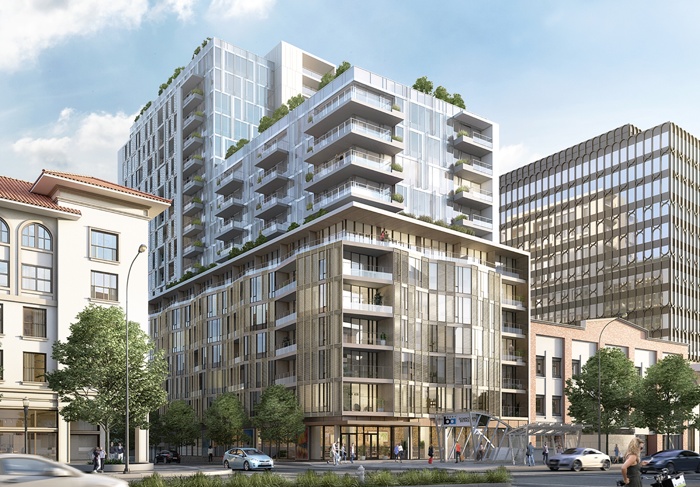
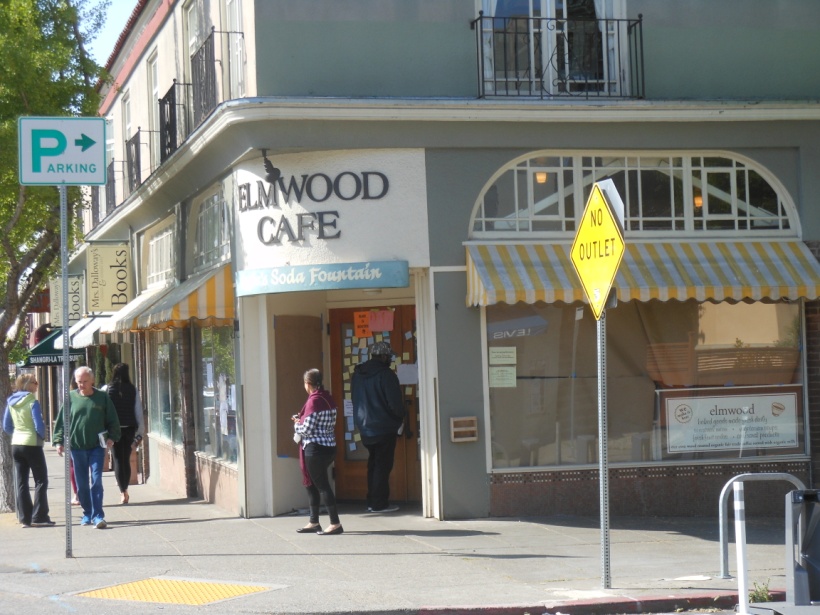 In 1950, Charles Osborne, a World War II ace fighter pilot, purchased the business, renamed it “Ozzie’s” and focused the business around the soda fountain. Shortly thereafter, it because a meeting place for the people who waged the successful fight against the extension of the 580 freeway down Ashby Avenue from the Claremont Tunnel to South Berkeley. Folks like Barbara Lubin who went on to found the Middle East Children’s Alliance and Marty Schiffenbauer, sometimes called the Father of Berkeley Rent Control and government by citizen initiative, became regulars.
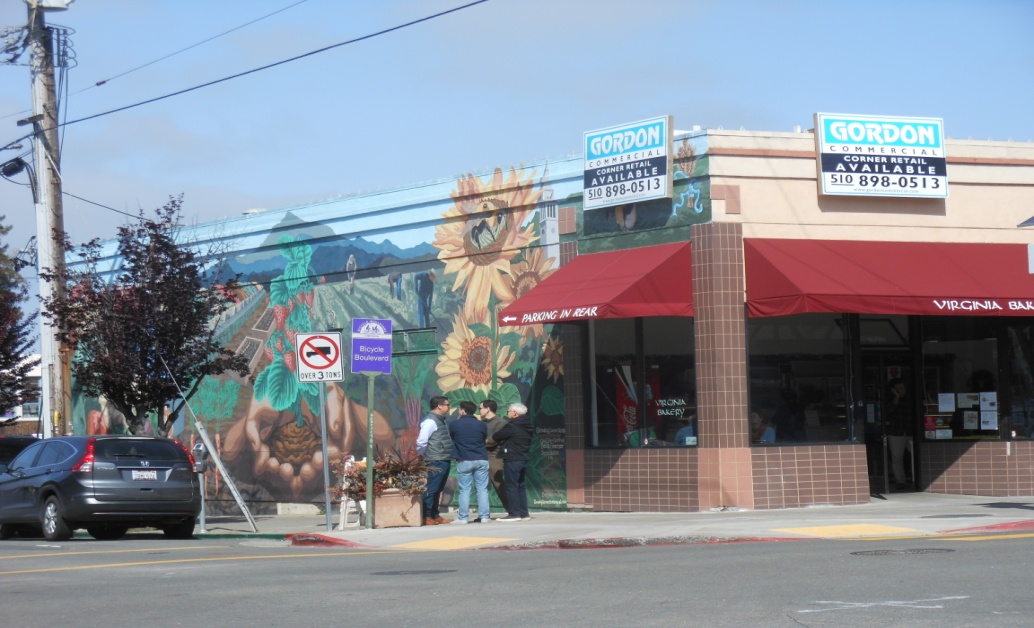 The Virginia Bakery, at 1690 Shattuck Avenue, has been the place to buy a premade cake or order a custom made one, along with such items as cookies, bear claws and dinner rolls.
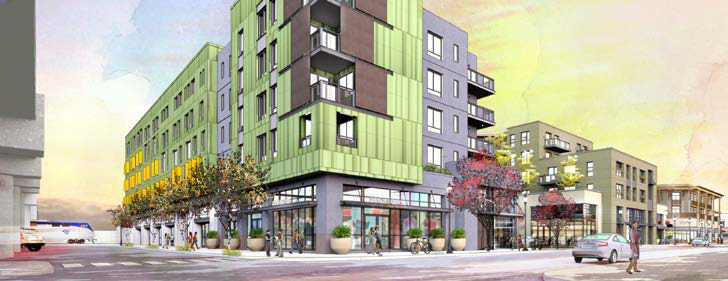 This graphic depicts the northwest corner of the proposed project at University Ave. and Fourth St. The elevated University Overpass is on the left.
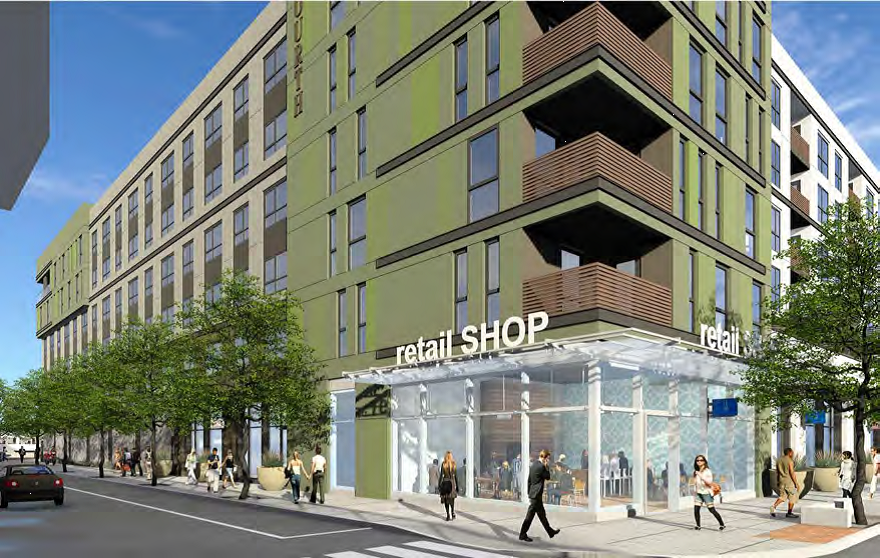 In March of 2018, a new project application was submitted – now with 260 units, with 50% of them to be for households with 80% of average medianincome (that’s $80.400/ year for a family of 4), somewhat reduced ground floor commercial space and fewer parking and bike spaces. Note: this is same view as the previous graphic with the elevated University Ave. Over-pass to the left.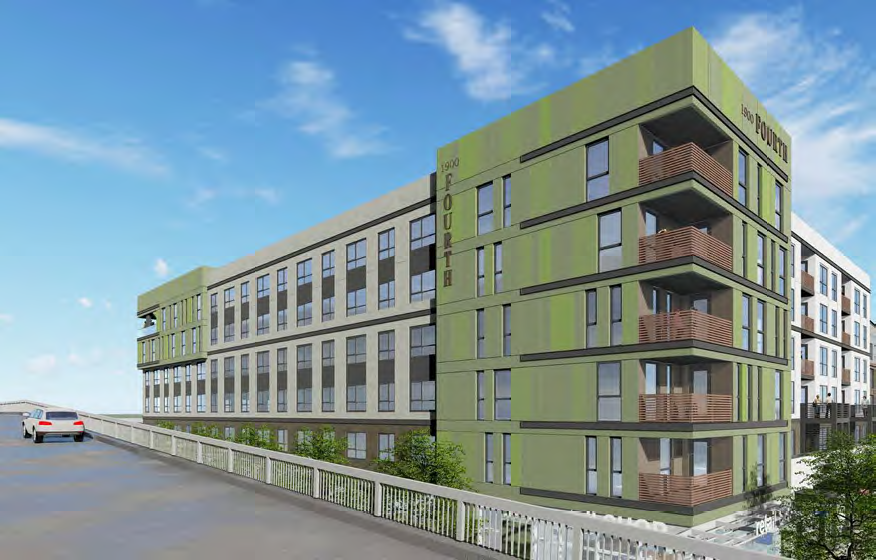
 Then in mid-June along came the news that routine sampling of the Berkeley reservoir at 1431 Summit Road and one in Orinda revealed a contaminant level of 80 parts per billion of THMs. THMs are the by-product of chlorine with naturally occurring organic such as leaves, brush, etc. matter in water. THMs are considered to be a cancer causing chemical and a cause for public health concerns when over 80 parts per billion is consumed over a period of time. The East Bay Municipal Water District has apparently known that levels of THMs were rising, but they don’t have to let the public know until the level is over 80 parts per billion until it happens for four quarters in a row. Apparently, the rising THM levels are at least partly caused by the drought, conservation efforts to reduce water usage, and warm temperatures. EBMUD began addressing the problem by flushing 90,000 to 120,000 gallons of water from the Summit Road reservoir into the Bay and are considering other short and long term actions.